
Plasma-technology + Fischer-Tropsch synthesis
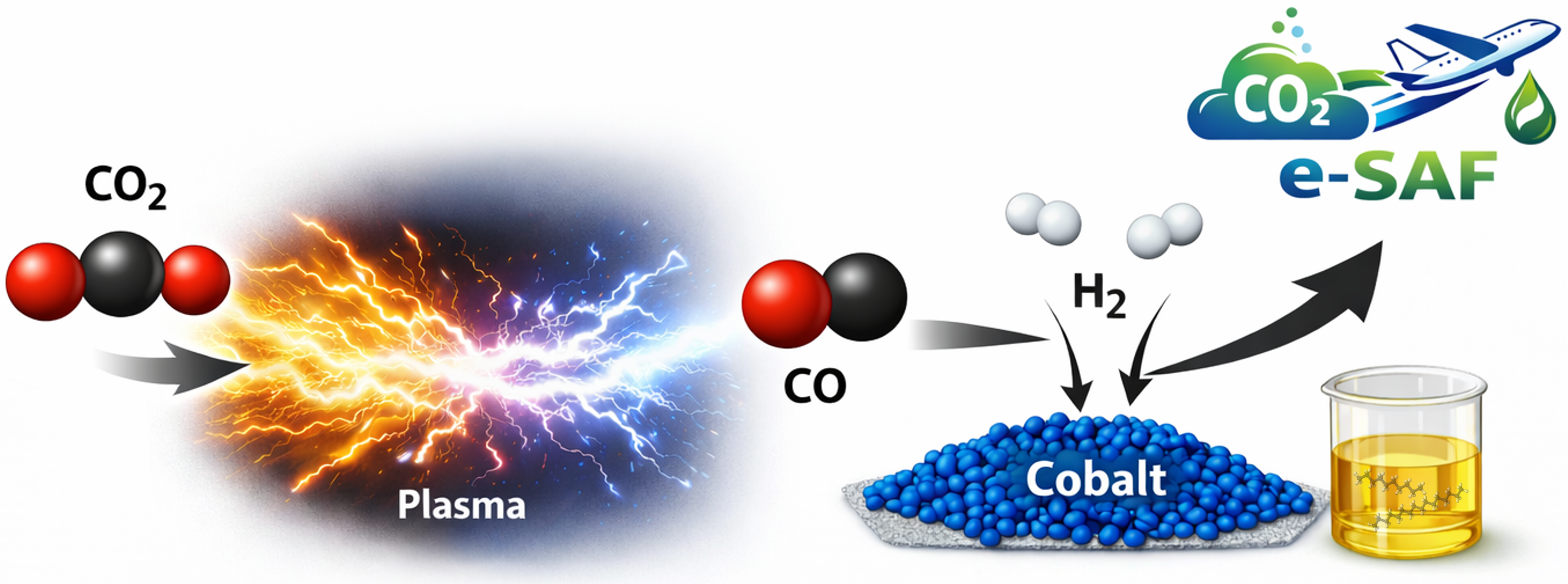
Plasma technology offers a promising pathway for CO2 activation to CO and for dry reforming of methane. Recent studies, including work by PLASMANT, have demonstrated that integrating a post-plasma carbon bed can markedly enhance CO2 conversion efficiency. This approach not only increases CO yield and lowers energy consumption, but also removes O2 from the product stream, simplifying downstream separation.
At the molecular level, reactive oxygen species (O/O2) produced during CO2 splitting, interact with solid carbon to form additional CO. When the carbon bed operates above 1000 K, the reverse Boudouard reaction (CO2 + C → 2CO) further boosts CO production. PLASMANT’s chemical kinetics modeling provides detailed insight into the surface interactions between O, O2, CO, and CO2 with solid carbon.
The plasma produced CO / H2 stream is then combined with renewable hydrogen for Fischer-Tropsch synthesis to produce long-chain hydrocarbon jet fuel precursors. Fischer-Tropsch synthesis has been studied in detail at the Laboratory for Chemical Technology (LCT) and detailed kinetic models have been developed.
The e-SAF project aims to demonstrate the unique integration between those technologies.
